
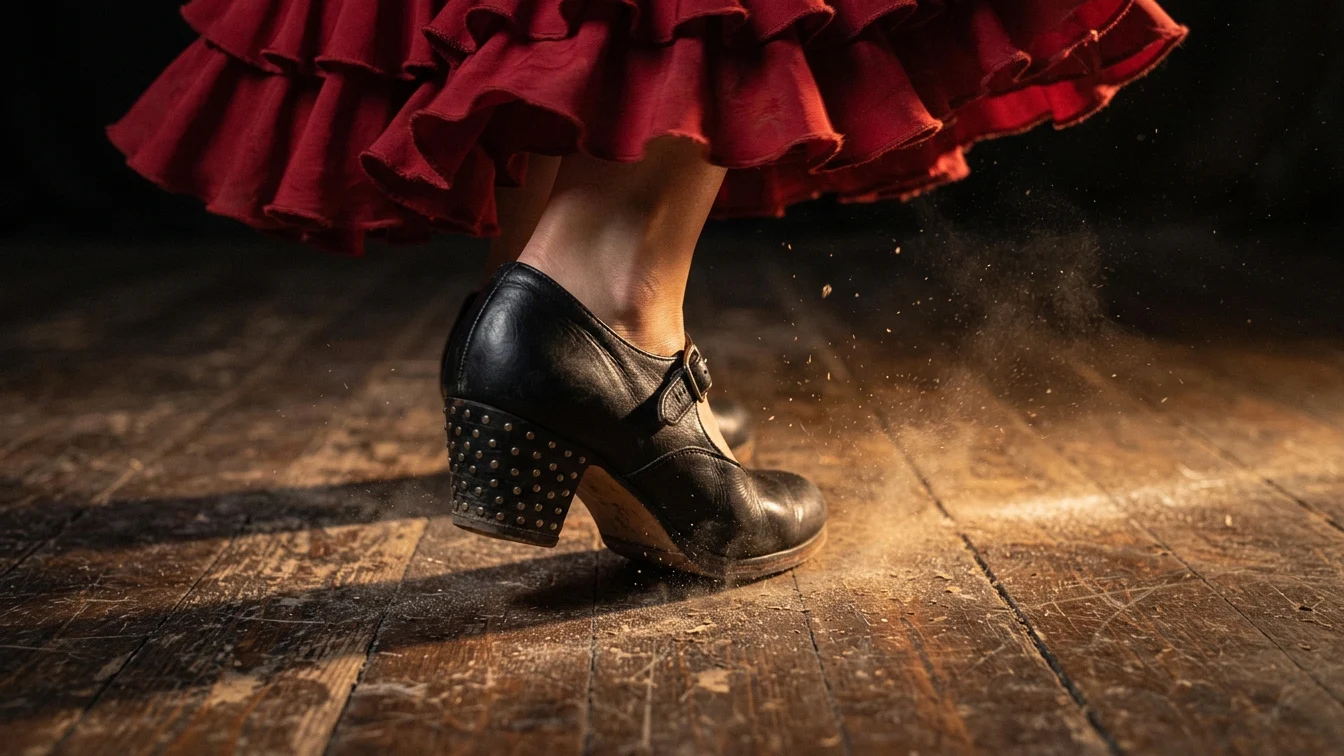
Flamenco footwork, called zapateado, is built from a handful of basic sounds made with the ball, heel, flat foot and tip of the shoe. Beginners learn them one at a time, slowly and quietly, until each strike is clean and even. Speed comes much later.
Footwork is the most exciting part of flamenco and also the one that most often causes pain when it is rushed. This guide explains the sounds, a simple practice method and how to protect your knees and shins.
The five basic footwork sounds
| Name | How to do it | Sound |
|---|---|---|
| Golpe | The whole flat foot strikes the floor, then lifts | Full, deep |
| Planta | The ball of the foot strikes the floor | Light, crisp |
| Tacón | With the ball down, the heel drops and strikes | Sharp |
| Punta | The toe of the shoe taps the floor, usually behind you | Short tap |
| Apoyo | The foot is placed with weight to step, without a strong sound | Soft |
Teachers name and combine these differently, but almost all footwork patterns are built from them.
Before you start: posture and surface
Footwork starts from your stance. Keep the chest lifted, the knees soft and the weight slightly forward, as described in our guide to flamenco posture. The upper body stays calm while the legs work.
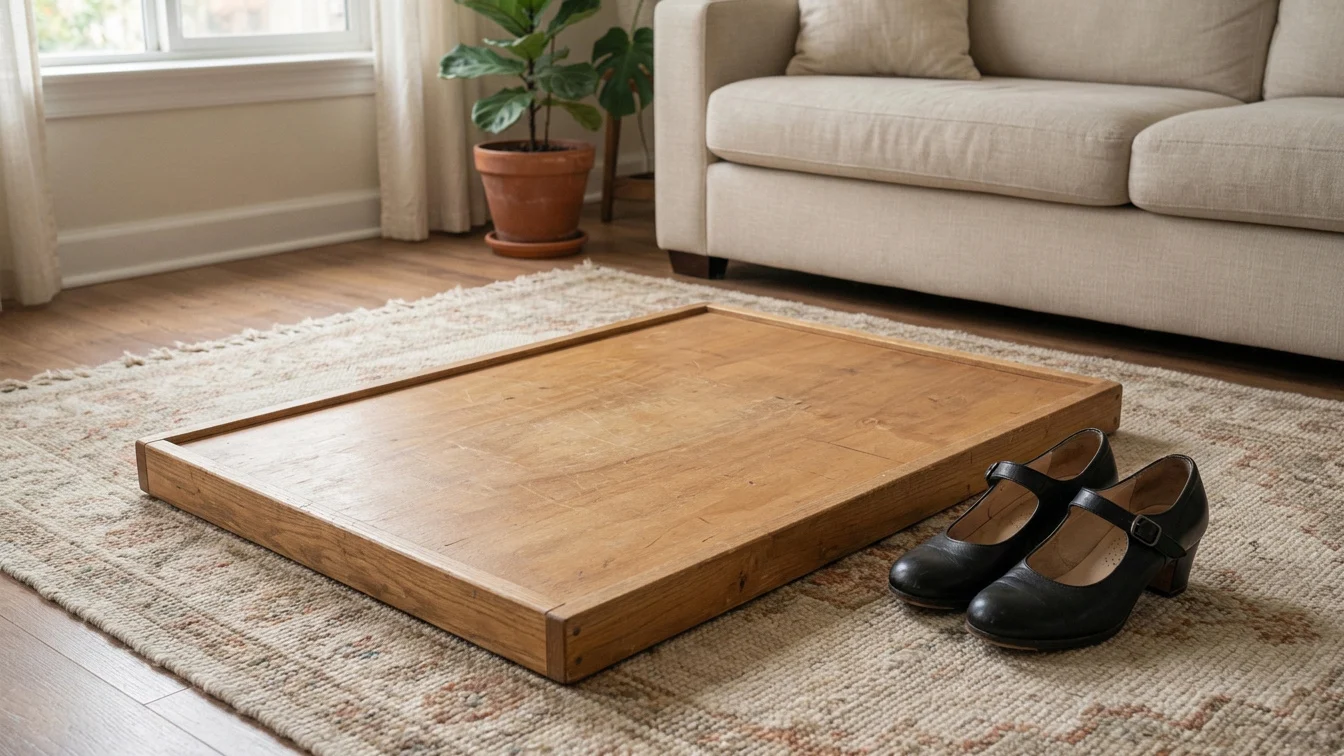
The surface matters just as much. Hard floors such as concrete or tile send impact into the joints, and carpet absorbs the sound and grips the shoe. A wooden floor or a plywood board placed over a rug gives a firm surface with a little give.
How to practice each sound
- Golpe: stand on the left foot, lift the right foot a few centimeters and let it drop flat. Repeat eight times, then switch feet.
- Planta: lift the right heel slightly and strike with the ball of the foot, keeping the heel up. Eight times per foot.
- Tacón: place the ball of the right foot on the floor and drop the heel to make the sound. The knee stays soft. Eight times per foot.
- Planta-tacón: combine the two on the same foot: ball, then heel. This pair is the base of many patterns.
- Alternating: planta right, planta left, tacón right, tacón left, at an even speed.
Count out loud and keep the same volume on every strike. If one sound is louder, slow down until they match.
A first exercise with a metronome
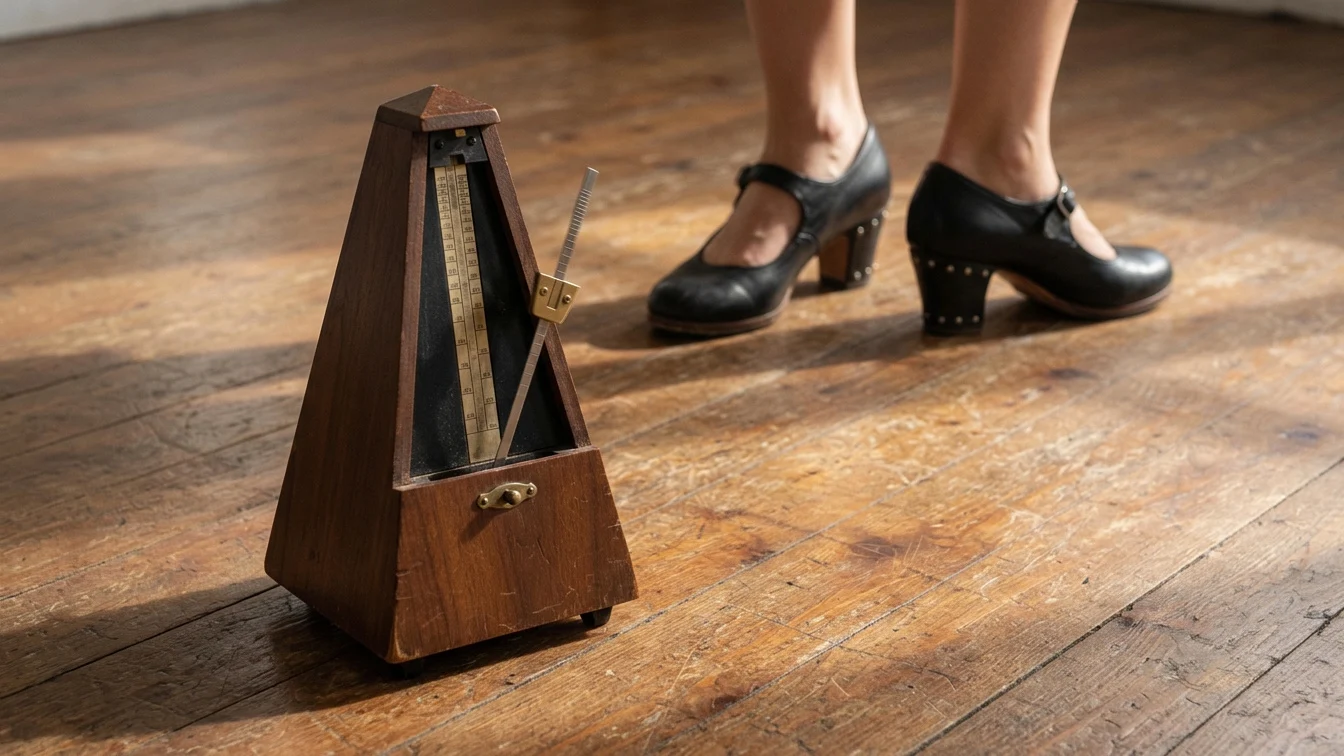
A metronome, or a free metronome app, turns practice into measurable progress. Start very slowly, around 60 beats per minute, and place one sound on each beat.
| Week | Exercise | Tempo |
|---|---|---|
| 1 | Golpe and planta, alternating feet | 60 bpm |
| 2 | Planta-tacón on each foot | 60 to 70 bpm |
| 3 | Planta-tacón alternating feet, continuous | 70 bpm |
| 4 | Add a golpe every fourth beat as an accent | 70 to 80 bpm |
This table is a gentle example, not a rule. Move on only when the current tempo feels clean and easy for several days.
From single sounds to short patterns
Once the individual strikes are clean, teachers start combining them into short patterns that repeat. These patterns train coordination and prepare you for real choreography. Three classic beginner patterns are:
- Planta-tacón alternating: right ball, right heel, left ball, left heel. Four even sounds that can be repeated as long as you like.
- Golpe-planta-tacón: a flat strike followed by ball and heel on the same foot. It creates a three-sound group that fits many flamenco rhythms.
- Accent pattern: three soft sounds followed by one strong golpe. It teaches you to control volume, which is essential for marking the accents of the compás.
When you practice patterns, keep the volume even inside each group and only make the accented sound louder. Recording your practice on a phone is very helpful: listening back shows uneven sounds that are hard to notice while dancing.
As patterns become comfortable, count them against the rhythm of a flamenco style. Many beginners first apply footwork to tangos, which has a clear four-beat feel, before moving to 12-beat styles such as soleá or alegrías.
A useful habit is to say the pattern out loud while you dance it, for example “ball, heel, ball, heel”. Speaking the sounds keeps your mind ahead of your feet and makes it easier to stay in rhythm when the tempo increases.
Mistakes that cause pain or bad habits
- Stamping with force: the sound should come from a relaxed, well-placed strike, not from slamming the leg down.
- Locked knees: they transfer impact into the joints. Keep a small bend.
- Bouncing the upper body: the torso should stay still while the feet move.
- Practicing too long: 15 to 20 minutes of focused footwork is enough at first.
- Skipping the warm-up: ankle circles, calf raises and marching in place prepare the joints.
The right shoes also help, because a firm heel and a nailed sole make the sounds clear without extra force. Our guides on flamenco shoes and attire explain what to look for.
Health note: this guide is general information and does not replace a qualified teacher or a health professional. Stop if you feel sharp pain in the knees, shins or feet, and see a doctor or physiotherapist if it continues.
Frequently asked questions
What is the difference between zapateado and tap dance?
Both create rhythm with the feet, but flamenco shoes have nails instead of metal plates, and zapateado follows the rhythmic cycles of flamenco styles. Flamenco footwork also uses the whole foot and heel more heavily.
Can I practice flamenco footwork without flamenco shoes?
For the first sessions you can practice the movements in firm shoes with a small heel. To hear clear sounds and protect the foot during regular practice, proper flamenco shoes are recommended.
How do I practice footwork in an apartment?
Use a portable dance board over a rug, practice at reasonable hours and focus on slow, controlled strikes, which are quieter. Some dancers practice the movement in soft shoes and save loud practice for class.
Why do my shins hurt after footwork?
Shin pain is often linked to too much practice too soon, hard floors or stamping with force. Reduce the volume, check your surface and technique, and see a professional if the pain continues.
Your next step
Practice the planta-tacón pair slowly this week, with a metronome. When it feels even, start applying it to rhythm, beginning with our complete beginner’s guide to flamenco dance.