
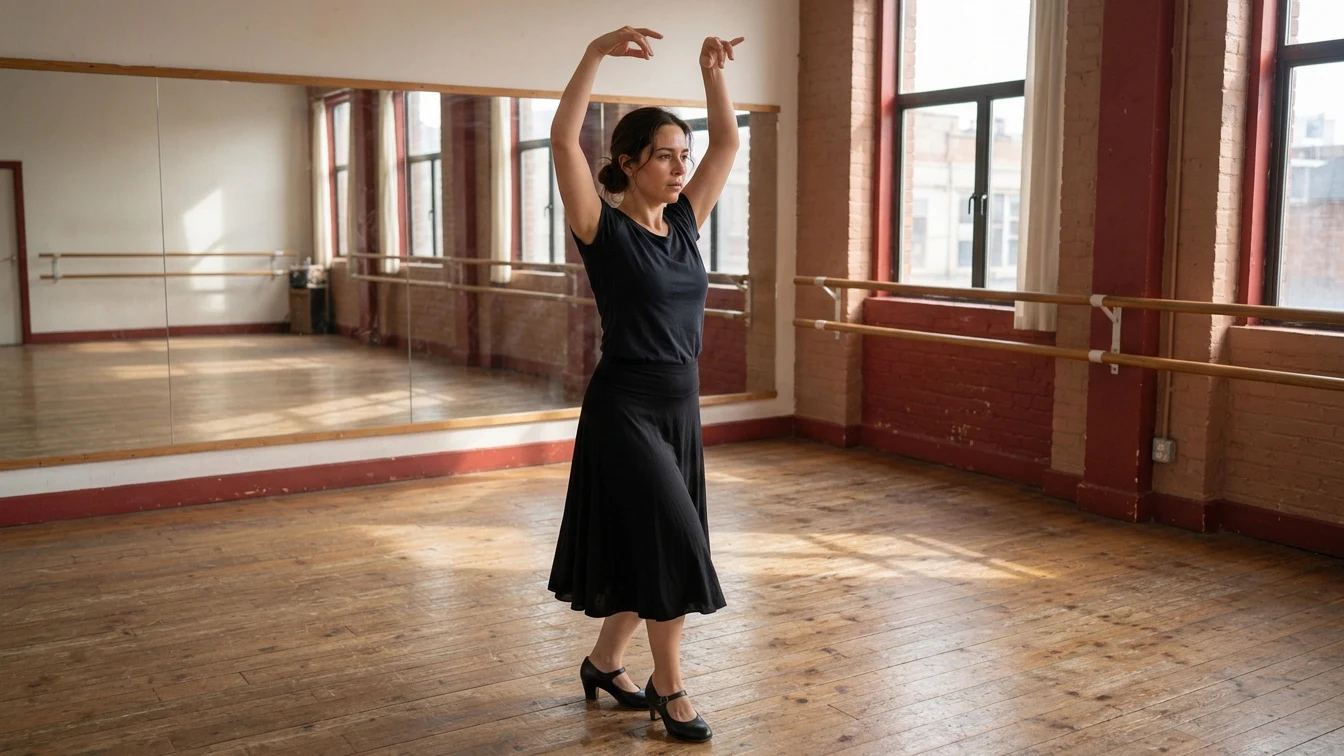
Flamenco dance for beginners starts with three things, and none of them is fast footwork: a strong, lifted posture, a basic sense of the rhythm and a few simple steps you can repeat without strain. Adults who begin with those foundations usually feel comfortable in a class within the first months, even if they have never danced before.
This guide walks you through the whole path, in the order most teachers follow: what flamenco is, how your body should be placed, how the arms and feet work, how to count the music, what to wear and how to practice at home between lessons. Each section points to a deeper guide in our Flamenco Basics section when you are ready for more.
What makes flamenco different from other dances
Flamenco is an art form from Andalusia, in southern Spain, that combines singing (cante), guitar playing (toque) and dance (baile). In 2010 it was inscribed by UNESCO on the Representative List of the Intangible Cultural Heritage of Humanity, which describes it as an expression shaped over centuries by many communities in the region.
For a beginner, three features stand out:
- The dancer is also a musician. Your feet, your claps and even your finger snaps add sound to the music, so rhythm matters as much as shape.
- The music follows fixed rhythmic cycles. Many styles count in cycles of 12 beats with accents in specific places, which is why counting feels strange at first.
- Improvisation lives inside structure. Experienced dancers react to the singer and guitarist, but always within the rules of each style.
What you will learn first, in order
Most beginner courses follow a similar sequence. Knowing it helps you judge your progress and avoid jumping ahead to steps that strain your knees.
| Stage | What you practice | Typical goal |
|---|---|---|
| 1. Posture | Lifted chest, long neck, relaxed shoulders, slightly bent knees | Hold the position for a full song without slumping |
| 2. Arms and hands | Braceo (arm paths) and floreo (wrist and hand circles) | Move arms slowly and smoothly while the body stays still |
| 3. Basic footwork | Golpe, planta, tacón and simple sequences | Clean, even sounds at a slow tempo |
| 4. Rhythm | Counting compás and clapping palmas | Mark the accents of one style with claps |
| 5. A first choreography | Often sevillanas or tangos, which have clear structures | Dance a short piece from start to finish |
Posture: the foundation of every movement
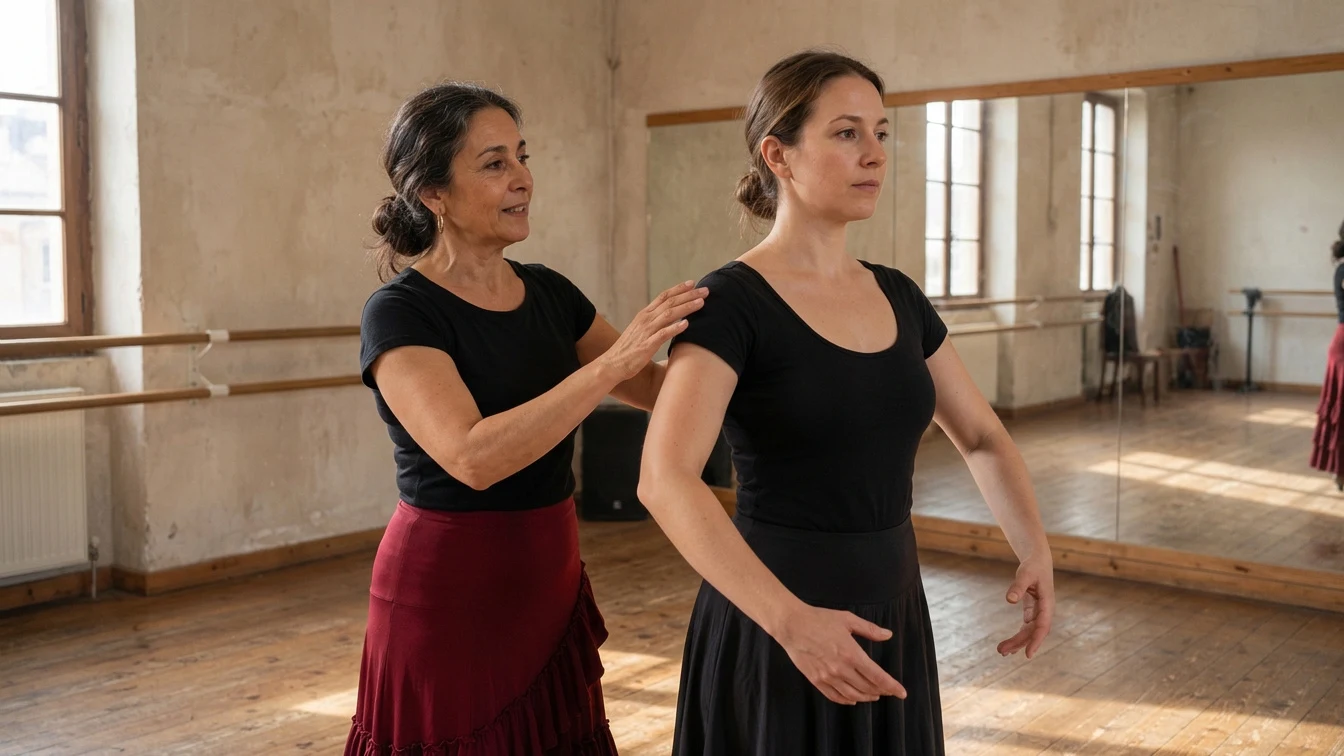
Flamenco posture looks proud and grounded at the same time. The chest is lifted, the shoulders stay down and back, the neck is long and the weight sits slightly forward over the balls of the feet, with the knees soft rather than locked. The lower back stays long, without arching.
Beginners often lift the chest by squeezing the lower back, which tires the body quickly and can cause pain. A useful check is to place one hand on your belly and the other on your lower back: you should feel the belly gently engaged and the back long, not pinched.
A quick posture routine
- Stand with feet together and knees slightly bent.
- Breathe in and let the chest rise without lifting the shoulders.
- Draw the shoulder blades down, as if sliding them into your back pockets.
- Lengthen the back of the neck and look straight ahead.
- Hold for 30 seconds, rest, repeat three times.
Arms and hands: braceo and floreo
Flamenco arms move in wide, rounded paths called braceo, while the wrists and fingers draw small circles called floreo. The movement starts from the back and shoulders, not from the hands. Women’s and men’s styles traditionally differ: hand circles are often more flowing in women’s dance and more contained in men’s, although modern teachers mix both.
Practice arms in front of a mirror with music playing softly. Move one arm at a time from the hip, up past the front of the body and over the head, keeping the elbow slightly rounded. When that feels natural, add the wrist circle at the top of the movement.
Footwork: start slow and quiet
Footwork, called zapateado, is the part every beginner wants to learn, and the one that most often causes knee and shin pain when rushed. The basic sounds are:
- Golpe: the whole flat foot strikes the floor.
- Planta: the ball of the foot strikes the floor.
- Tacón: the heel strikes the floor while the ball stays down.
- Punta: the tip of the shoe taps behind you.
Keep the knees soft and let the sound come from the floor contact, not from stamping with force. Clean, even sounds at a slow speed are worth more than fast, uneven ones. Most teachers ask beginners to practice short sequences at a slow metronome speed for weeks before increasing tempo.
Rhythm: understanding compás
Compás is the rhythmic cycle of each flamenco style. Some styles, such as soleá, alegrías and bulerías, use a 12-beat cycle with accents on beats 3, 6, 8, 10 and 12. Others, such as tangos and rumba, use a more familiar four-beat feel. Sevillanas, often taught first, follow a triple-time pattern organized in short, repeating sections.
The fastest way to absorb compás is clapping. Clap all 12 beats evenly while counting aloud, then clap louder on the accented beats. Once you can do that with a recording, your footwork will start to fall in the right places almost on its own.
What to wear to your first classes
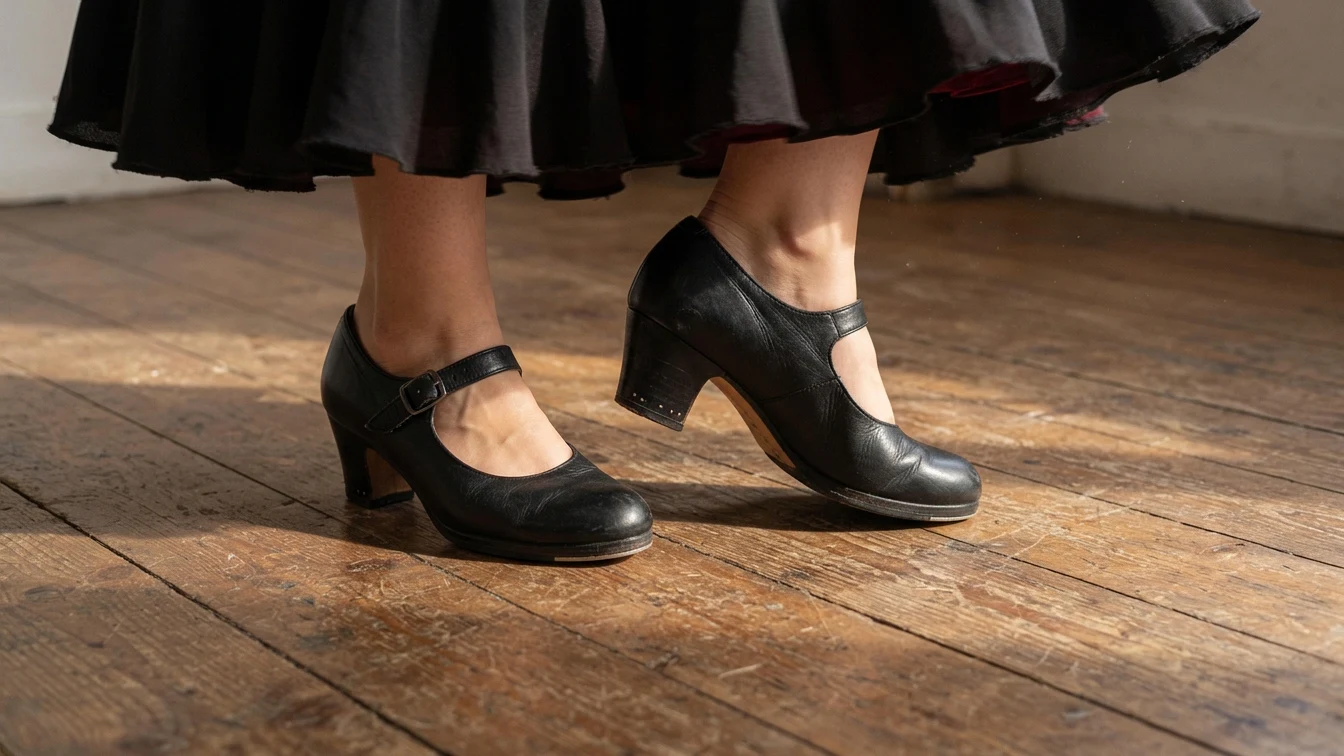
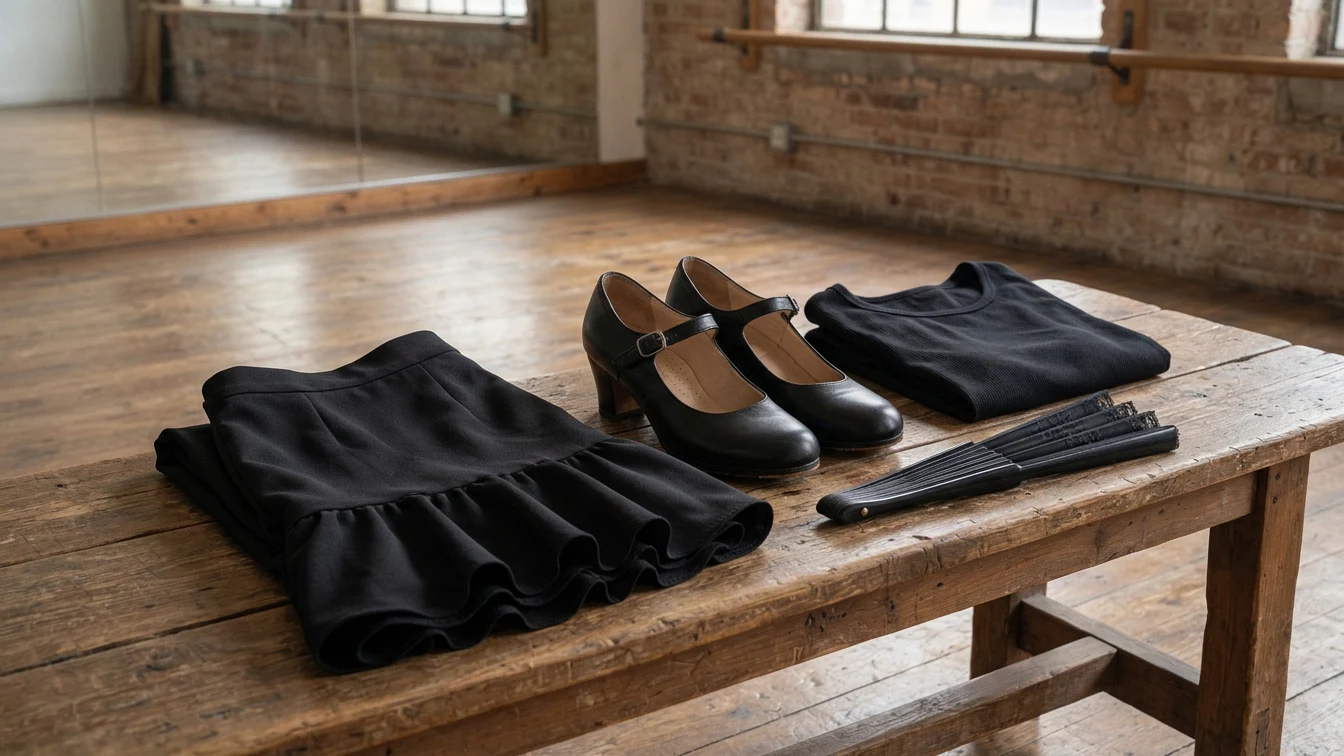
You do not need a full costume to begin. For the first lessons, comfortable clothes and a pair of shoes with a small heel and a smooth sole are enough. As you continue, the two purchases that make the biggest difference are:
| Item | Why it matters | When to buy |
|---|---|---|
| Flamenco shoes | Firm heel and nailed sole produce the sound and protect the foot | After a few classes, once you know you will continue |
| Practice skirt | A wide skirt teaches you how to move the fabric and shows your foot placement | When your class starts using skirt work |
| Comfortable top | Lets the teacher see your posture and arm line | From the first class |
Our Shoes & Attire guides explain sizes, heel heights and what to avoid when you buy your first pair.
How to practice at home without hurting yourself
Practice between classes speeds up learning, but footwork on the wrong floor can damage your joints and your home. Concrete and tiles are hard on the knees, and carpet absorbs the sound and catches the shoe. A sheet of plywood on top of a rug, or a purpose-made dance board, gives a firm, slightly springy surface.
- Warm up for five to ten minutes with marching, ankle circles and gentle knee bends.
- Keep sessions short at first: 15 to 20 minutes of focused work is enough.
- Alternate footwork with arm and posture drills to rest the legs.
- Stop if you feel sharp pain in the knees, shins or feet.
As a general health reference, the NHS physical activity guidelines for adults recommend at least 150 minutes of moderate activity a week, and dance practice can count toward that. More ideas are collected in our Practice at Home section.
Health note: this guide is for general information and does not replace a qualified dance teacher or a health professional. If you have knee, hip, back or foot problems, talk to a doctor or physiotherapist before starting footwork.
Common mistakes adult beginners make
- Rushing the feet. Speed without control creates uneven sounds and strain. Slow, clean repetitions build speed safely.
- Looking at the floor. It collapses the posture. Look ahead and feel the steps instead.
- Tense shoulders. Lifted shoulders make the arms look stiff. Breathe out and let them drop.
- Ignoring the music. Learning steps without counting makes them hard to use later. Always practice with rhythm.
- Comparing yourself to performers. Professional dancers train for many years. Measure progress against your own first class.
How to choose your first class or teacher
A good beginner class makes the first months much easier. When you compare options, in person or online, look at a few concrete points rather than at how impressive the teacher’s performances are:
- A real beginner level. The class description should say it is for people with no experience, and the first lessons should focus on posture, arms and slow footwork.
- Warm-up included. A teacher who starts every class with a warm-up is thinking about your joints.
- Counting out loud. Teachers who count the compás and explain where the accents fall help you understand the music, not only copy steps.
- Individual feedback. In small groups the teacher can correct your posture and foot placement. Online, look for classes that review videos or offer live correction.
- A clear progression. Ask what you will be able to dance after a term. A short, complete choreography is a good sign.
If there is no school near you, online classes combined with a few in-person workshops a year work well for many adults. Whatever you choose, record yourself every few weeks: comparing videos shows progress that is hard to feel from the inside.
How long does it take to feel comfortable?
There is no fixed timeline, because it depends on how often you practice, your previous experience and the style you study. What most teachers agree on is that consistency beats intensity: two regular classes a week plus short home practice will take you further than an occasional long session. Expect the first months to focus on posture, arms, simple footwork and one beginner-friendly choreography.
Frequently asked questions
Am I too old to start flamenco?
Many people start flamenco in their thirties, forties, fifties and beyond. Classes for adult beginners are common, and the dance values expression and presence as much as athletic ability. If you have health conditions, check with your doctor before starting footwork.
Do I need a partner to learn flamenco?
No. Flamenco is mostly danced solo or in groups where each dancer has their own space. Some styles, such as sevillanas, are danced in pairs, but classes rotate partners or teach the steps individually.
Can I learn flamenco only online?
Online classes are a good way to learn posture, arms, rhythm and choreography. A teacher who can see you in person, or review your videos, helps correct footwork and alignment, which is harder to judge alone.
Which flamenco style should a beginner learn first?
Many schools start with sevillanas or tangos because their structures are clear and repetitive. Others begin with simple exercises in soleá or alegrías rhythm. Follow your teacher’s plan and focus on counting correctly.
Is flamenco a good workout?
Flamenco works the legs, core and arms and raises the heart rate during footwork sections. It can be part of an active lifestyle, as long as you warm up and progress gradually.
Your next step
Start with the body: posture is the base for every other skill, and it is something you can practice today in front of a mirror. Then work through our beginner guides on posture, arms and first steps in order, and read how Flamenco del Mar prepares its guides if you want to know who is behind them.